
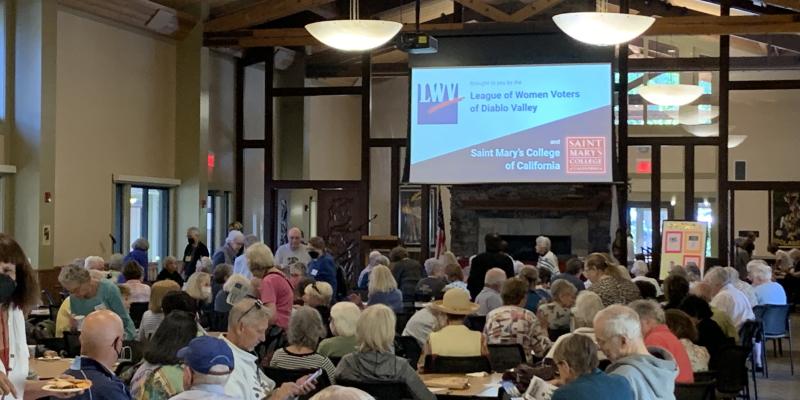
THANK YOU to all of you who attended this special event!
As promised, below are the questions directed to our panelists. Some of the questions listed below were answered at the Forum (in whole or in part), and some were not. Please check back, as we will post answers from our panelists as soon as they are able to kindly provide.
(Disclaimer:
The information contained in this question and answer section is for general information purposes only. This information is provided by the League of Women Voters of Diablo Valley and while we endeavor to keep the information up to date and correct, we make no representations or warranties of any kind, express or implied, about the completeness, accuracy, reliability, suitability or availability with respect to the information contained in this section. Any reliance you place on such information is therefore strictly at your own risk. The inclusion of this informational material in this section does not necessarily imply a recommendation or endorse the views expressed within them.)
_____________
Question # 1 for Kari Fisher, Counsel for the Farm Bureau:
Why can't agriculture evolve to dry farming, or drip irrigation? Or, a combination? How much (of drip irrigation, dry farming, or the like) is already happening?
_____________
Question # 2 for Panel
The water legislation package appears to be severely flawed. If it is defeated, what should be done next?
:
Answer submitted by Susanna Schlendorf, District Director for Assemblymember Joan Buchanan The 4 policy bills + SB 1, Delta Conservancy, Delta Plan; SB 6, Groundwater Monitoring; SB 7, Statewide Water Conservation; SB 8, Water Diversion and Use + are now law. The Water Bond (Safe, Clean and Reliable Drinking Water Supply Act of 2010) will be on the ballot in November. The $11.14 Billion Bond is flawed + the portion that goes toward the Delta and water supply reliability is too small in comparison to funding for projects that have little to do with the co-equal goals. The bond measure should be defeated. Funds from measures that voters have already approved (Propositions 1 E and 84) should be used to improve Delta levees and insure water quality.
Answer Submitted by David Nesmith: The Water Policy Legislative Package has many flaws. Many environmental groups and most all fishing and Delta interests opposed it. It has passed through the State Legislature and has been signed into law by the Governor.The final part of the package must be submitted to the voters and is scheduled for the November 2010 election. It is an $11Billion General Obligation Bond that would fund many very problematic projects such as 2-3 new dams, and some parts of a Peripheral Canal Project. Furthermore, the annual debt payment on these bonds when sold will be around $800 million per year for 30 years. This money will come out of the State's general fund budget before any other obligations are met, including child health, education, parks or prisons. Many groups throughout the state are organizing to defeat this Bond.
Answer submitted by Dr. Gregory Gartrell: The only part of the water legislation that is not now law is the Bond proposal that will be on the ballot in November. If that fails, there will certainly be discussions and possible legislation on alternatives for funding necessary Delta improvements. There are currently several bills under consideration that are attempting to address issues in the water legislation that remained or were not fully addressed last year.
I.O. Skaredoff, Contra Costa RCD (Resource Conservation District)
_____________
Question # 3 for Karla Nemeth, Liaison, CA Natural Resources Agency and BDCP (Bay-Delta Conservation Plan):
Have Delta fish species declined because of failure to comply with the Endangered Species Act? If not, what is the primary reason for the decline?
A: There is no "smoking gun" that has caused the decline of fish species. Fish species that are the focus of the BDCP are in decline for several reasons. The current pumping system driven by the State Water Project and the Central Valley Project has created unnatural flows that pull from North to South, leading to entrainment of fish and disruption of their natural habitat. In addition, lands that historically provided intertidal marsh habitat have been disconnected by levees and dikes, resulting in less habitat for fish and for their food sources. Other stressors such as non-native invasive species, predation and toxic contaminants have also contributed to the decline of species. The BDCP aims to enhance and restore fish habitat including seasonal flood plain, tidal marsh and natural hydrologic conditions to keep fish away from water intakes and help them thrive in the Delta estuary.
_____________
Question # 4 for Kari Fisher, Counsel for the Farm Bureau:
Does the California Farm Bureau support mandatory removal of toxins (such as selenium) from farm irrigation run-off?
_____________
Question # 5 for Karla Nemeth, Liaison, CA Natural Resources Agency and BDCP (Bay-Delta Conservation Plan):
How can we "maintain water quality" for fish, drinking and recreation (e.g. swimming) in all regions of the Delta (north and south) if we build a canal that diverts water around the Delta?
A: The BDCP will analyze this spring the effects of proposed water facilities and operations on sensitive fish regulated by state and federal endangered species laws. Initial water modeling indicates that water quality would remain largely within current standards. In addition, a key feature of the BDCP is restoring the role of tidal marsh habitat as a natural regulator of salt intrusion into the Delta.
_____________
Question # 6 for Panel:
Given the amount of federal dollars that have been pumped into the state water project, and the fact that the Fresno region is the top AG (agricultural) producer in the U.S., why is Fresno also the poorest per capita in the U.S.?
Answer Submitted by David Nesmith: Fresno County westside agribusiness has received over 50 years of highly subsidized irrigation water. Though there are many other parts of the state where the agricultural economy depends on government supplied irrigation water, none of that water is as highly subsidized by the taxpayers of the nation. Westside agribusiness has succeeded in concentrating the benefits of this largess into the hands of very few large corporate family owners of land there. They have been extremely effective at maintaining powerful political support, and telling compelling, if entirely false, stories about the desperate farm workers who do the work on their lands. Would that Senator Feinstein asked this question, and sought real answers to the real economic problems of the Westside!
_____________
Question # 7 for Karla Nemeth, Liaison, CA Natural Resources Agency and BDCP (Bay-Delta Conservation Plan):
How many Delta residents are on the BDCP?
How many business owners are on the BDCP?
How many recreational fishermen are on the BDCP?
How many commercial fishermen are on the BDCP?
How many Delta farmers/ranchers are on the BDCP?
A: Currently there are no individual landowners, recreational fishermen, commercial fishermen, or Delta farmers on the Steering Committee. The BDCP steering committee is comprised of state and federal agencies, water districts, environmental organizations and other organizations interested in preparing a conservation plan that helps restore the Delta ecosystem and permits the reliable operation of the state and federal water projects. The BDCP Steering Committee discusses and decides on key elements of an eventual proposed Plan. All Steering Committee meetings are open to the public.
_____________
Question # 8 for Kari Fisher, Counsel for the Farm Bureau:
Define the terms 'farmers' and 'ranchers'.
What is the average size of a 'farm', and of a 'ranch'?
Define AG business. Who are they?
_____________
Question # 9 for Karla Nemeth, Liaison, CA Natural Resources Agency and BDCP (Bay-Delta Conservation Plan):
The BDCP Chapter 3 is scheduled for approval by the steering committee next week. So far, the website has no response to comments sent in. Will these comments be considered? And why hasn't this been indicated on the website?
A: The BDCP Steering Committee expects a full draft conservation strategy, including Chapter 3 to be released in the fall of 2010. Once the public draft is released, a formal public comment period will be initiated. In the meantime, all public comment letters are reviewed and shared with the Steering Committee and posted on-line. In addition, a summary of public comments made during the September 2009 BDCP workshops has been transmitted to the Steering Committee for consideration and posted online. _____________
Question # 10 for Kari Fisher, Counsel for the Farm Bureau:
What is the Farm Bureau's position on agricultural businesses reselling water for non-agricultural use?
_____________
Question # 11 for Panel:
What is happening regarding federal oversight, especially for the federal canal system?
Answer submitted by Susanna Schlendorf: Neither the federal government nor California actions and programs have been successful in halting the decline of the Delta ecosystem or improving the reliability of California's water supply. The well-intended federal/state CALFED program proved to be costly, underperforming, unfocused and lacking accountability. In December 2009, an Interim Federal Action Plan for the California Bay-Delta was released by 6 federal agencies with the goal of coordinating the federal response to the California water crisis and to facilitate a partnership with California.
Answer submitted by Dr. Gregory Gartrell: Currently, the federal canal system ( Delta Mendota Canal ) is governed by Reclamation law, administered and executed through the Secretary of the Interior, the Federal Endangered Species Act, as regulated by biological opinions delivered by the U.S. Fish and Wildlife Service and National Marine Fisheries Service, and a federal court. Since the rules are subject to change somewhat independently, the system is not operating efficiently at all and that is one reason the Bay Delta Conservation Plan and the Delta Vision were started.
Answer Submitted by David Nesmith: Federal Oversight of the Federal Central Valley Project is carried out by the Bureau of Reclamation. This agency's primary mission is to purvey water to its contractors. It is not in BuRec's interest to conduct careful and critical oversight to their contractors, especially in the areas of wider environmental impacts or long-term implications of water used to fulfill the contracts. Fish are not contractors. Tax payers are not contractors. Urban water users are not contractors, with a very few exceptions.
_____________
Question # 12 for Susanna Schlendorf, 15th Assembly District Director for Joan Buchanan, and for Dr. Gregory Gartrell, Assistant Manager of the Contra Costa Water District:
What is the 'Delta Plan'? Can you please describe it?:
Answer: SB 1 requires the Delta Stewardship Council to develop, adopt, and commence implementation of a comprehensive management plan for the Delta (Delta Plan), by January 1, 2012. The Delta Plan is intended to guide state and local actions in the Delta in a manner that furthers the co-equal goals of Delta restoration and water supply reliability.
_____________
Question # 13 for Dr. Lawrence Kolb, former Assistant Director for the Water Quality Board (retired):
Could you define the borders of west San Joaquin County?
ANSWER: What I meant to say was the west side of the San Joaquin Valley. This term means a strip of land that is generally bounded by I-5 on the west and the middle of the valley on the east. What makes the west side different from the east is the geology and soils. West side soils are derived from marine sedimentary rocks from the Coast Range. These soils are high in salts, including toxic selenium. The west side is much dryer than the east, so there are has been relatively little flushing of salts over time. In contrast east side soils are derived from the granitic rocks of the Sierra, and they receive water from Sierra snow pack. East side agriculture is mostly sustainable, and west side is not.
_____________
Question # 14 for Dr. Lawrence Kolb, former Assistant Director for the Water Quality Board (retired):
What would be the most effective method to reduce and control the thousands of chemicals and pollutants (e.g. plasticides, pharmaceuticals, pesticides, endocrine disrupters, etc.) in the Sacramento and San Joaquin Rivers, Delta and Bay?
ANSWER: Most pollutants are broken down in conventional sewage treatment, but there are some that are not. There are two possible approaches: chemical by chemical regulation, or a general upgrading of the sewage treatment plants. I believe the ultimate solution will be some combination of these two. Some chemicals can be either banned outright or their uses restricted. That is the situation for Diazinon today. It may well be that we will discover so many other chemicals that are not removed in conventional biological treatment, that case by case regulation will not be feasible. In that event, the solution would be a kind of extended (enhanced) biological treatment. This is already being required of dischargers to the South Bay below the Dumbarton Bridge: San Jose, Sunnyvale, and Palo Alto.
_____________
Question # 15 for Susanna Schlendorf, 15th Assembly District Director for Joan Buchanan:
FUNDING: Is anyone thinking about using bond money to decrease water use instead of building the peripheral canal? Examples might be funds for covering the canal area (maybe with PV panels) and for developing hydroponic farming?
ANSWER: The $11.14 Billion Water Bond does not include funds to build a conveyance. It does include $2.25 billion for "Delta Sustainability" of which $1.5 billion can be used for mitigation of impacts of a conveyance. Cost estimates for building a conveyance are $50-75 billion.
_____________
Question # 16 for Dr. Gregory Gartrell, Assistant Manager of the Contra Costa Water District:
What is Contra Costa's plan for increased salinity resulting from sea level rise? Has the county considered desalinating water?
Answer: First, it is not clear increased sea level rise will result in increased salinity. It could, but it will depend on the response. If the response is to allow or create new tidal marsh (or restore old tidal marsh) in the Delta, the result could be fresher water. Depending on what the actual change is, CCWD is prepared. All CCWD facilities can accommodate sea level rise for the next 50 years or longer. If there are increased salinity levels, CCWD already has projects in the planning stages or about to go on line. These include the Alternative Intake Project which provides access to fresher water in the Delta, the Los Vaqueros Reservoir Expansion Project, and a multi-agency desalination project that includes a partnership with East Bay Municipal Utility District, Santa Clara Valley Water District and San Francisco Public Utilities District.
_____________
Question # 17 for Dr. Lawrence Kolb, former Assistant Director for the Water Quality Board (retired):
Are agricultural users paying the true costs of water use, or are there subsidies? (federal or state)
ANSWER: Water itself is free in California, and that's a big part of our problem. Users must only pay the cost of delivery to the point of use. For the federal Central Valley project, users do not pay the true costs - they are subsidized. For the later California Water project (state funded and more or less parallel to the CVP) users do pay full delivery cost. Delivery cost means amortized cost of construction of dams and pipelines plus operating costs.
The real problem is that such costs, even if paid in full, encourage waste. Most ag users pay around $20 an acre-foot (one acre of water one foot deep). This makes it economical for California farmers to grow even very water consuming low-value crops like alfalfa, the state's single largest user of water.
We cannot continue to preach water conservation while giving it away. We need some form of pump tax, not so much to raise revenue as to discourage waste. For example, if we had a $100 an acre-foot tax on water taken from nature, and applied this to the 43 million acre feet of water that farms and cities use, the revenue would be around $4 billion per year. This would help but not solve the state's budget woes. But such a tax would cut ag water use overnight. Growers would end their unwillingness to use reclaimed water, stop growing low value high water demanding crops, and start getting serious about drip irrigation.
_____________
Question # 18 for Dr. Gregory Gartrell, Assistant Manager of the Contra Costa Water District:
What is the advantage of a peripheral canal over the present system?
Other than decreased water use, is there any other way to solve the problems of the present system?
Answer: The main advantage is that it allows screened intakes in new locations that might be able to reduce the impacts of exporting water on fisheries. However, the level of new impacts and the advantages will depend upon both the size of the facilities, their location, and most importantly, the rules governing the use. Certainly, if rules are not included that protect the Delta and fisheries, any new conveyance method could increase salinity and have bigger impacts on fisheries than the current system. That is what the Bay Delta Conservation Plan is working on, and one of the most important parts will be the rules and the ways to alter the rules to meet objectives as things change in the future.
All independent science groups that have examined the Delta system, as well as the Governor's Blue Ribbon Task Force, have concluded that reduced water use must be part of a solution, but it is not the only part. Reduction in pollution, stopping new invasive species, screening intakes, storage to allow flexibility in the timing of diversions and habitat restoration will all play an important role in restoring the health of the Delta.
_____________
Question # 19 for Dr. Gregory Gartrell, Assistant Manager of the Contra Costa Water District:
How can we maintain a quality ecosystem with a policy of putting a dam or gate on major connections?
Answer: Barriers and gates have been part of the Delta system for over 60 years, and include the Delta Cross Channel Gates, the Montezuma Slough Structure, the Old River barrier and the South Delta barriers. Each has a particular purpose and all are, to a certain extent, addressing problems created by changes over the past 150 years, including the draining of the Delta tidal marsh land and construction of connections between natural channels. Since it is not possible to go back to the kind of Delta that existed in the 1850's, barriers will probably be part of any future solution if they can be shown to help protect fisheries and improve conditions.
Roger DiFate, Discovery Bay
_____________
Question # 20 for Karla Nemeth, Liaison, CA Natural Resources Agency and BDCP (Bay-Delta Conservation Plan):
Can you provide the metrics on:
1. How much water (threshold window) should the Delta have in order to maintain an eco-healthy status.
A: Currently there is no single answer to this question. BDCP is using the best available science to determine what flows allocated to the state and federal water projects are needed to stay in the estuary to protect and help fish recover. This information will be part of the Draft BDCP scheduled for release during the Fall of 2010. As mandated by the recent water legislation, the State Water Resources Control Board has begun hearings to determine flow criteria for the Delta from all upstream tributaries.
_____________
2. How much water the Delta has had (actual metrics) yearly, over the past 10 years.
A: The California Data Exchange Center (http://cdec.water.ca.gov) has data related to flows in California rivers and tributaries on a current and historical basis. This is a great reference for historical Delta flows.
3. If the water bond passes (as it is written right now), how much water should we expect (future forecast) the Delta to have each year, for the next 10 years.
A: The water bond represents an overarching, statewide approach to solving many of California's water challenges. It does not authorize the construction of a water conveyance system (or canal) in the Delta nor provide funding for environmental mitigation of new Delta conveyance water facilities. The bond includes funding for a portion of the BDCP habitat restoration efforts that would contribute to the recovery of Delta fish and wildlife over time, a voluntary and more rigorous standard than otherwise required for state and federal endangered species act compliance
4. If the water bond does not pass, how much water should we expect (future forecast) the Delta to have each year, for the next 10 years.
A:As noted above, the November 2010 water bond does not authorize the construction of a conveyance system (or canal). The BDCP will continue to move forward regardless of whether or not the November 2010 water bond passes or fails.
Water
POSITION IN BRIEF: Support measures which promote the management and development of water resources in ways that are beneficial to the environment with emphasis on conservation and high standards of water quality that are appropriate for the intended use.
POSITIONS
Planning and Management of Water Resources
1. Support measures that:
a. coordinate water resource planning with land use planning and provide for future needs without encouraging growth;
b. protect the natural environment in areas of both water origin and water use;
c. reserve stream flows for protection of fish and wildlife habitat and other in-stream uses;
d. preserve wild and scenic rivers;
e. encourage off-stream storage; discourage additional onstream dams;
f. provide for assessment of economic, social, and environmental costs and benefits of water projects;
g. discourage water contracting and marketing policies which build up demand and establish rigid patterns of distribution and use;
h. encourage a variety of water supply sources with emphasis on nonstructural alternatives;
i. develop and maintain a statewide inventory of ground and surface water supplies and a centralized database to evaluate current and potential needs, demands, and uses;
j. require that documents present clear, concise information, readily available to the public.
Water Quality Control
2. Support measures that:
a. give state and regional boards responsibility for setting water quality standards that may be higher than minimum federal standards;
b. give state and regional water quality control boards sufficient authority and adequate budget and staff to establish and enforce water quality standards;
c. promote coordination of regional water quality control boards with other agencies concerned with both water quality and quantity.
Surface and Groundwater Supplies
3. To ensure protection and efficient use of groundwater and surface water supplies, the state should:
a. modify water rights law to facilitate coordinated management and use of surface and groundwater resources;
b. develop and enforce policies, standards, and guidelines to coordinate basin-wide groundwater and surface water management;
c. identify local, basin, or regional groundwater management areas;
d. set and enforce standards for groundwater management with local, basin, or regional development and implementation of plans tailored to the carrying capacity and characteristics of each basin;
e. review management plans periodically to assure compliancewith state mandated policies, standards, and guidelines;
f. have a statewide program for groundwater management.
Fiscal Objectives
4. Support measures that:
a. require fish and wildlife enhancement, flood control, and recreation costs be borne by the general taxpayer;
b. require other costs be paid by the water and power users;
c. encourage water pricing policies which reflect development and delivery costs;
d. protect low or fixed income water users by lifeline rates;
e. encourage flexible water contracts to reflect costs and benefits more font size="-2"accurately.
Conservation
5. Support measures that:
a. encourage conservation by all categories of water users through pricing policies, technical assistance, metering, education, and changes in water rights law;
b. require rationing in emergency situations only;
c. encourage the use of reclaimed water for power plant cooling, groundwater recharge, agricultural, and landscape irrigation;
d. require water conservation as a condition placed on the delivery and use of water for agriculture;
e. require implementation of conservation measures before inter-basin transfer of water should be made available.
Protection of the Sacramento-San Joaquin Delta and San Francisco Bay Estuary Ecosystem
6. Support measures that:
a. increase water conservation and promote waste water reclamation to minimize reliance on water exported through and around the Delta;
b. foster federal and state coordination and cooperation over all Delta operation and manage ment;
c. require federal and state entities to abide by high water quality standards;
d. set limits on the amount of water to be exported through or around the Delta;
e. require strong, binding environmental safeguards as a part of any cross Delta transfer system.
Adopted 1959; Updated 1961, 1967, 1971, 1979; Readopted at the last convention
© Copyright
League of Women Voters of Diablo Valley, California. All rights reserved.